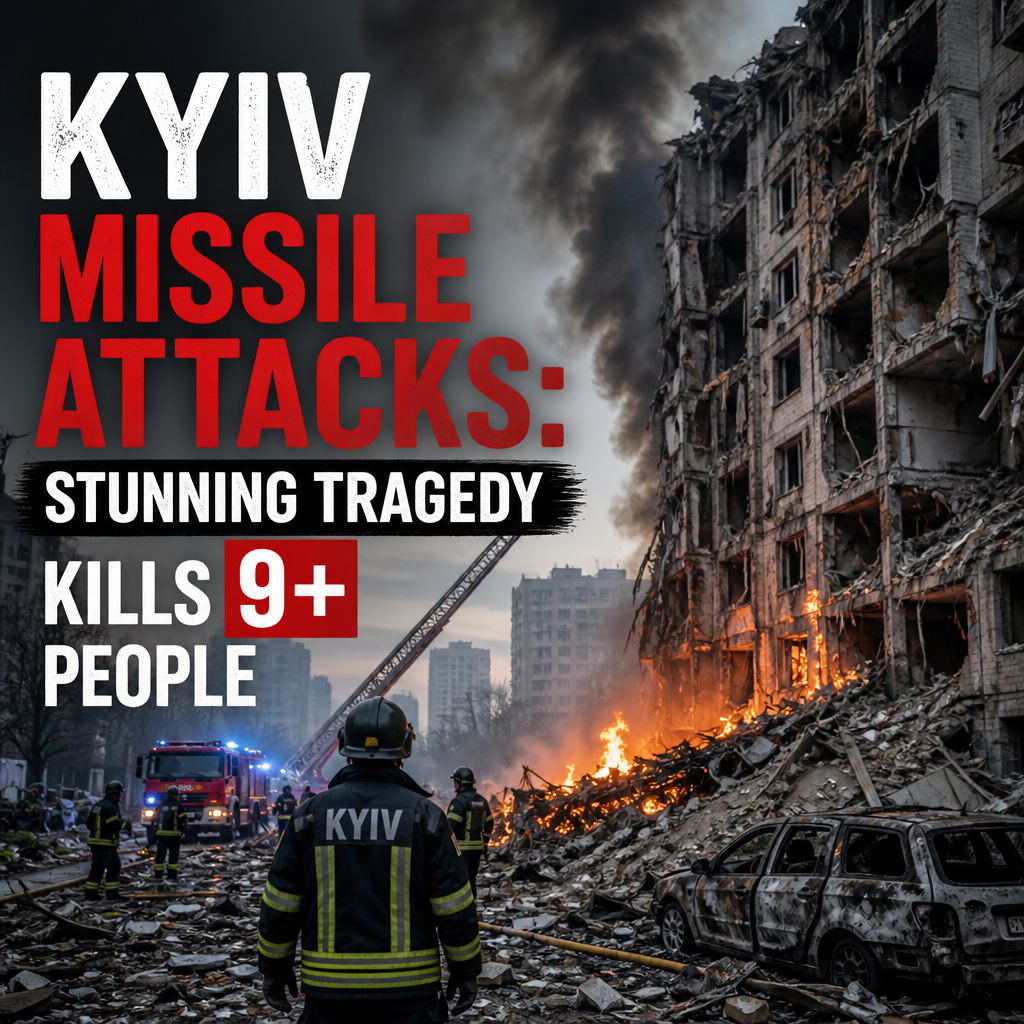
Kyiv Missile Attacks: Stunning Tragedy Kills 9+ People


Kyiv missile attacks have once again exposed how fragile life remains in Ukraine’s capital, with reports saying at least nine people were killed and many more injured in a barrage that struck residential areas and other parts of the city.
The immediate facts are stark: explosions, casualties, damaged buildings, emergency crews working through debris, and families forced to confront the aftermath of another night of war. What makes this attack especially grim is not only the death toll, but the way it reinforces a pattern that has become painfully familiar since Russia’s full-scale invasion began — civilians in a major city remain vulnerable even far from the front line.



Kyiv missile attacks and the human cost
Across the available reporting, there is broad agreement on one point: the attack caused serious civilian harm. Al Jazeera’s coverage emphasized the scale of the tragedy and the death toll, while Sky News typically frames such incidents through the lens of humanitarian impact, emergency response, and the strain on Kyiv’s air defenses and medical services. That focus matters, because numbers alone can obscure what missile strikes mean on the ground: shattered homes, disrupted hospitals, frightened children, and exhausted rescue workers searching through rubble.
The human toll is not limited to those killed. In attacks of this kind, the injured often outnumber the dead, and many more people experience shock, displacement, and loss. Even when buildings remain standing, the psychological damage can be profound. People in Kyiv have lived with air raid alerts long enough to know how quickly ordinary routines can be transformed into scenes of panic.




There is also a broader strategic dimension. Missile strikes on a capital city are rarely just about military effect; they send a message. They test a population’s resilience, pressure local authorities, and signal that no place is fully safe. For Ukraine, that creates a constant balancing act between keeping the city functioning and protecting civilians from sudden, high-impact attacks.
Kyiv missile attacks: competing narratives and what they mean
The interpretation of the attack differs sharply depending on the source. Ukrainian and international outlets focused on the casualties, the destruction, and the fact that civilian areas were hit. Russian-facing coverage, including RT, is more likely to present such strikes in the context of military objectives, air defenses, or retaliation for Ukrainian actions elsewhere. That contrast is important because it reflects the information war running alongside the military one.
From a reporting standpoint, the most responsible approach is to separate claims that are verified from claims that are asserted. What can be said with confidence is that a missile attack on Kyiv caused deaths and injuries, and that the city’s civilian population bore the brunt of the impact. What is harder to confirm immediately in fast-moving wartime coverage is the exact military purpose behind every strike, the full number of missiles launched, and the complete damage assessment. Those details often emerge gradually, and sometimes they remain disputed.
A fair reading of the situation suggests three things:
– Civilian suffering is not incidental when major cities are struck.
– Both sides use messaging to shape how the attack is understood internationally.
– Reliable casualty counts and target assessments can take time to verify.
This is why it is sensible to be cautious about any narrative that treats the event as neatly explained. In wartime, governments, military officials, and state-linked media all have incentives to frame events in ways that support their broader goals. That does not mean every account is equally credible, but it does mean readers should pay attention to what is confirmed, what is inferred, and what is still uncertain.
A broader pattern of danger
The latest strike also underscores a difficult reality: Kyiv has become a symbol of endurance, but endurance is not the same as safety. Repeated missile attacks can wear down infrastructure, strain public services, and create a persistent sense of instability even when defenders intercept many incoming weapons.
There is also a political dimension that stretches beyond Ukraine. Each major attack renews calls from Kyiv for more air defense systems, more ammunition, and faster international support. Western governments, meanwhile, face their own debates about how much aid to provide, how quickly, and for how long. Those decisions are shaped by military assessments, domestic politics, and fears of escalation.
What is easy to miss in high-level discussions is that every round of bombardment has a local human face. Emergency workers must clear collapsed structures. Hospitals must absorb new casualties. Parents must decide whether to keep children home from school. Residents must decide whether to stay in the city, leave, or simply try to keep living as normally as possible under abnormal conditions.
The tragic reality of the latest attack is that it fits a pattern without making that pattern any less devastating. The reports do not suggest a clean or immediate resolution, and there is no clear sign that the violence is easing enough to spare civilians from further losses.
For now, the most defensible conclusion is a sober one: Kyiv has endured another deadly strike, the death toll is severe, and the competing narratives surrounding the attack should not distract from the central fact that ordinary people paid the price.